
Smells Like Knowledge
The only thing better than going to a library is staying in a library

I was a library kid. If you’re a self-proclaimed nerd like me, you know exactly what that means—a kid who secretly wanders the universe inside her own head, who relies on a musty, book-stuffed building as map room, train station, and hiding place. To this day, nothing inspires more excitement or gratitude in me than a public building stuffed with far too many books for me to ever consume. It’s so bountiful, so generous, that there must be a catch: you (or anyone) can go into this blissfully quiet building, linger all day, pick out almost anything, and take it home? And they just trust you to bring it back? It’s too good to be true.
I was privileged to grow up in a town with a Carnegie Library, and it was one of the items I put on my long list of wishes as we looked for a place to land four years ago. A good library is the nerd version of a neon sign blinking “your kind welcome here.” (A town with a library, yarn store, old theater, and coffee shop is the nerd equivalent of the Las Vegas strip; but that’s a different story.)
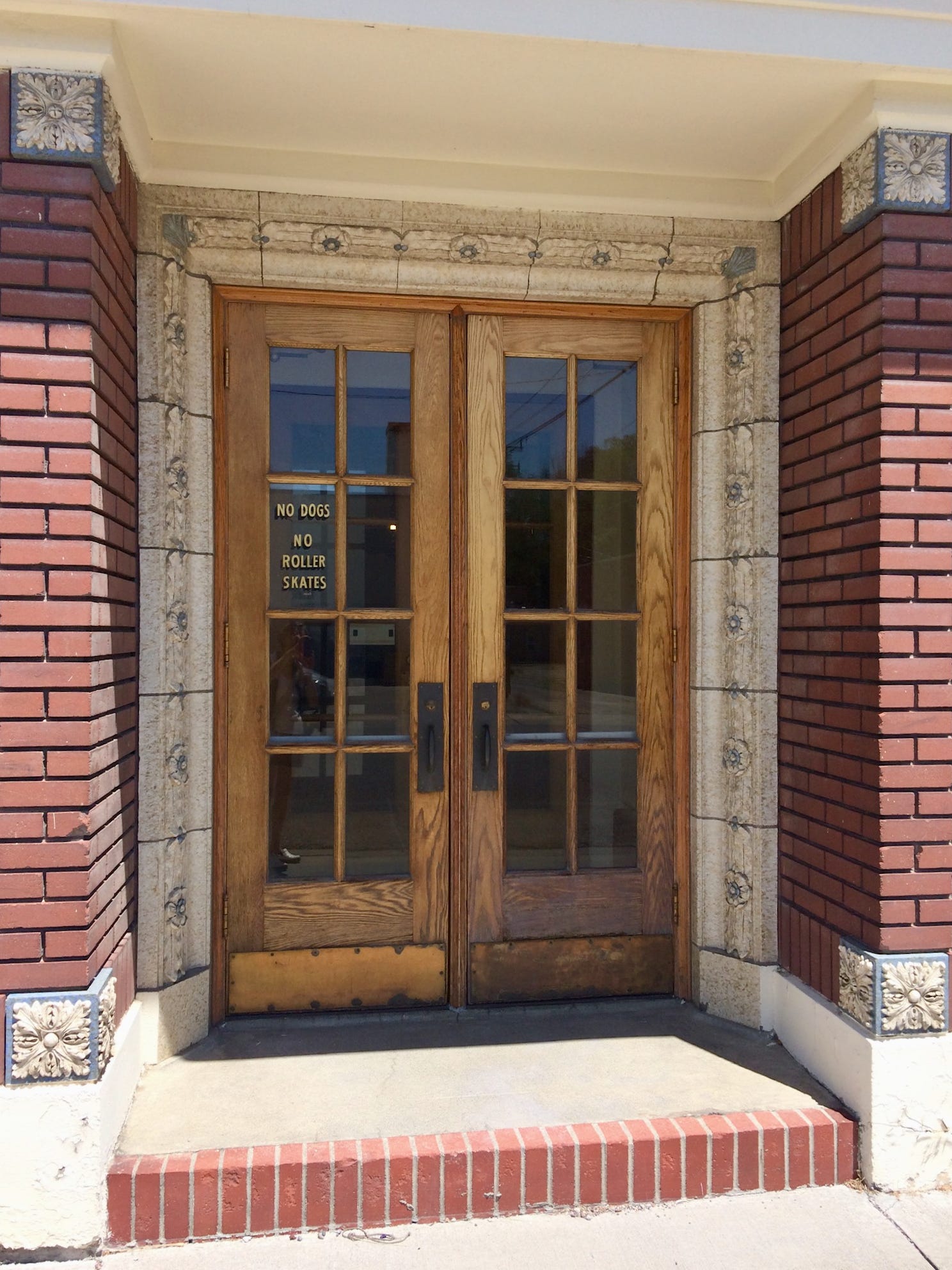
The best thing about the library I haunted as a child was not the books, however; it was the nostalgia accumulated long before I arrived. The side entrance to the children’s section in the basement had a thick oak door inset with windows, and hand-painted in gold with delicate black shadowing on one windowpane were four beautiful lines:
NO DOGS
NO
ROLLER
SKATES
This is poetry to me, simple evidence of a time when kids skated from home to the public library with unleashed dogs happily running alongside. I saw the ghosts of panting dogs and rusted skates loitering on the steps, and wished they were waiting for me.
The front entrance to the library faced the railroad tracks, once a source of great pride in my town. The nearby passenger depot was torn down long before I was born, but its architecture had the classic swooping eaves. These two buildings must have been quite a proud pair, showing off the town’s wealth and magnanimity along with a collection of handsome stone churches and my old junior high school. The saloons and hotels were on the other side of the tracks, naturally.
By the time I arrived, railroad tracks were for counting boxcars and telling horror stories—a puppy with its tongue frozen to the rail, a foolish boy whose foot wedged in a switch, newlyweds in a car that sputtered and stalled—all within earshot of an oncoming train. My own tale of railroad woe involves the black ’69 VW Beetle my family kept; at least three of us learned to drive in it. We heard its final owner abandoned it on the tracks in a field south of town, where it met its end on the cow-catcher of a locomotive. I understand why Dad sold it, but I’m still a little miffed. In my heart, I know the car was melancholy without us and rolled itself onto the tracks in despair.
But back to the library: a short flight of stairs inside that hand-lettered door led down to the children’s department and a greeting from the kindest woman on the planet. I never learned her name, but she was somehow bright, energetic, calm, and soft-spoken all at once. I never saw her hush the children who entered her domain, she just set an example and gently guided them into their own state of bliss with books they didn’t yet know they needed.
I had a short stint of working in a library myself, in college, but nothing so public; I was the book mender, tucked away in a windowless room with a bubbling glue pot, a heavy-duty clamp, and a workbench littered with tools: needles and heavy thread, a hand saw for hacking off derelict spines, thick repair tapes in black, navy, crimson, and forest green, and racks of tattered books awaiting my love. I knew some of them would never be treated with respect, so I kept them there, unrepaired, in protective custody. Never trust a college audience with a richly illustrated Kama Sutra.
My college library didn’t offer the same comfort or nostalgia as my childhood haunt; nor did any of the other modern libraries I encountered, but I felt at home there anyway. They were a source of something “new” when I was too broke to shop. They both piqued and satisfied my curiosities, no matter my mood. I chose them in lieu of churches when I needed comfort. I brought my son into those hallowed places and trusted them to welcome him into his own imagination and fullness.
One of my proudest moments as a parent was pausing outside the ornithology library at my workplace with Ethan at my side. He was eight or nine, and he grabbed my hand as we passed through the double doors and said, “Mom, wait… I just want to smell it.”
I was all business, running some errand with him in tow on a day off from school, but he insisted I slow down and sniff. It was that unmistakable blend of old paper and dust, mixed with ink, feathers, sweat, and the unconscious breath of thousands, if not millions, of people who paged through these volumes. The archives in that building held falconry tomes that were printed when Gutenberg was still alive. The library held the collections of pioneering biologists who carried their books from the Arctic circle to the tropics, hauling them in dogsleds or heavy rucksacks because these silent companions were so very essential to their work. These books literally held the world inside them. I took a deep breath, and I had to admit, it was good. I asked my son what it smelled like.
“Smells like Knowledge,” he said, huffing a deep, satisfying breath.
Knowledge. Yes.
I know what libraries have done for me, but it’s harder to say what I can do for them. I could join a “friends” fundraising group or my local library board, but the contribution I most want to make is a written one. The only thing better than going to a library is staying in a library, even if the part that stays is just a bit of my essence for a future library kid to find. It reminds me of a line from one of Sting’s songs: “send your love into the future.”
My love is a story, a memoir about a bookish artist making sense of her marriage to a firefighter when a freak accident almost kills him. It’s called Widow Practice, and if it’s ever published, it will be my pleasure to sign copies for all my early readers (that’s you). I don’t need to see my name on posters or bookstore promos, but I’d be ever-so-happy to find this book someday at a public library, any public library. Only then will I feel like I’ve made it: Knowledge. I hope it still smells the same.
Amy, this was so wonderful.
I worked at the County Library out in Hadlock from 1988 to 2013. I got to see a little girl who first came to the Library as a baby, come in with her own baby years later. I kept a list of Narrative Non-fiction books with their call-numbers to give to bored husbands waiting for their wives and kids. Many of them found a title to pull them to the shelves and check something out. I loved helping children doing a report the night before it was due, and showing kids special books that were like no others. (Have you ever seen the book, Zoom?) I repaired books, called people about overdues, filed the cards of books that were checked out (before computerization), put the covers on new books, and worked on the Reference desk.
My most unusual request was one evening when a young man said that he needed a drawing showing how to tie a neck-tie. I knew the perfect book and we went to the shelf, but it was not there and I couldn't find anything else had that kind of information. (The library was very small then.) I said that I knew how to tie a tie, but wasn't sure that I could draw it. He said that he had a tie in the car, and I realized that he was dressed up except for his tie. I tied it for him like he was my brother, then showed him how he could open it and take it off without untieing it, and he took off.
It was a fabulous life for me - I love people and books - and I was so lucky to have that job.
Thank you for writing this. The smell of books - yes!
Pamela Elicker at 303 Myrtle.
Libraries -- a national treasure!