
October wind
Aunt Marge said the hardest thing is almost always right. Just do the hard thing.

We’re driving east on an arrow-straight dirt road. I know it well, or did; like a favorite hat that’s been in the lost-and-found for twenty years, I’m glad to wear it even if it we don’t fit each other so well now. This road leads to the farm our grandparents homesteaded in eastern Colorado more than 100 years ago, my mom’s birthplace, the land where my uncle and aunt farmed and ranched and found oil and my cousins now do the same.
It is October, the month of long goodbyes. The day before closed hot and bright, but its successor brings thin sunlight, a temperature drop of 40 degrees, and wind. Such wind! I spot vaguely familiar landmarks—a naked fallen tree, a weathered cattle chute, a church on a hill far away—but the wind insists I am nothing but a stranger here. The wind owns this land and everything left on it.
At home in Washington, our coastal wind gusts pluck trees and batt down power lines, but rarely is the wind unleashed. Forests, bluffs, rolling hills, and ocean waves all conspire to soothe and give it voice. Not so with the wind that gushes across the plains of Colorado—it doesn’t slow to howl or huff. It is unrelenting, mad with momentum, never pausing to take a breath or say what it wants.
We drive east between parallel barbed wire fences; the wind drives south, and it’s not alone. It herds tumbleweeds, and before chuckling at the charming cowboy poetry of a tumbling tumbleweed, first imagine a vast plain, littered waist-deep to every horizon with placid skeletal shrubs grazing bare ground. Once their stems snap loose from the rocky soil, these shaggy beasts sprout muscle and sinew. The wind breathes spirit into millions at once, all stamping sparks among them, jostling, rubbing shoulders, then erupting with thunderous speed across flat ground.
The tumbleweeds coalesce into a living herd, arc like a flock of swallows crossing the sky, then shatter and multiply and do it again. They slam into fences unharmed, leap up without cause or intent. They are the wind incarnate, and though they may congregate in shelter or snag on a rusty post, nothing slows them for long. They will break their own limbs off just to keep rolling in the raw freedom of the wind.
Through the midst of this stampede my sister-in-law drives confidently in a rented taupe SUV, wipers flapping to keep the dust from completely blinding the windshield. In low spots she steers around the milling tumbleweeds and I tease that it won’t hurt them to be run over. “Yes, but they get revenge with a terrible noise,” she answers, and sure enough, the death throes of a tumbleweed dragging in the undercarriage grate like slow chalk on an old blackboard for the next half-mile. She grew up on a farm in Idaho, but says she’s never seen anything like this.
There is nothing like this, I think, awe-struck. Grandma must have felt this, but worse, for weeks on end during the Dust Bowl. She must have thought the world was dying, the wind scouring each rock and bone before snuffing out the sun.
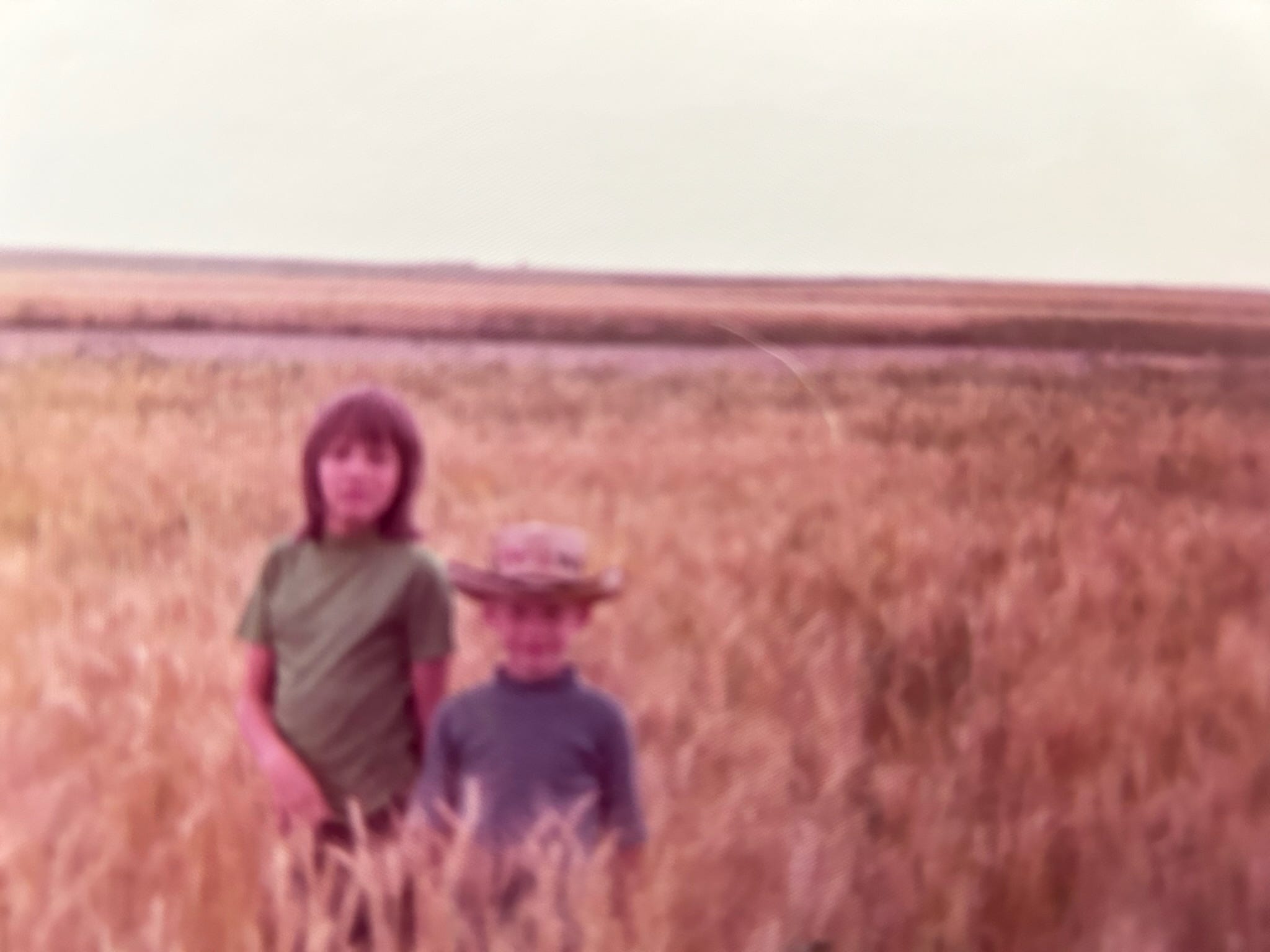
I have in my memory an image of a young-ish Grandad, tall and thin as a sunflower stalk, coated in dirt but also scarlet from sunburn, a band of stark white forehead preserved by his hat. But this image could not be Grandad; there was certainly no camera in those lean times. This memory must be my uncle, or a cousin after a day on the tractor, in the 1970s and early 80s when we still came every summer.
I wanted to be hardened like them, to witness the impersonal grandeur of a place bigger than me and see if I could earn my keep there. My parents had other ideas. I don’t regret college or my design career, but I do feel slightly handicapped—I don’t know how to kill a rattlesnake or tell when the wheat is ready. I’ve never stitched up my own cut or used a cowboy boot as a makeshift cast. Yet I’ve seen the deep blue shadow of a thunderhead over a golden field, and I’ve smelled the scent of raindrops on thirsty ground. I was privileged to stand in girlish innocence on this glorious prairie without doing any of the hard parts.
We arrive at the little church in plenty of time for our aunt’s memorial celebration, careful to keep the car doors from the wind’s grasp as we open them. Inside, it’s packed—everyone loved Aunt Margie—and throughout the Bible passages and slideshow and music and speeches, the wind never abates, never takes a breath. We didn’t scatter any ashes that day; the wind would have deposited them, with a tumbleweed escort, somewhere in New Mexico or even Oklahoma.
I surprise myself by muttering “oh what the hell,” then stand up to speak. I’m not exactly eloquent, but I speak slowly enough to keep my voice from shaking. I talk about asking Aunt Marge for advice, and how her answers always pointed the same way: the hardest thing is almost always right. Just do the hard thing. Speaking to a room full of strangers is hard, but I see my cousins nodding at me in agreement and remember why I came: sometimes the best you can do for a bereaved soul is show your face. If your face looks anything like their missing loved one, so much the better. You are there to steady them, to reflect their still-living faces, and to help them do a hard thing if they’ll let you.
I don’t know why I’m writing this. Something in me wants to document how I survived a stampede of ghost buffalo, tumbleweeds, new familiar faces, old landmarks, words, memories, sorrow, and joy—all driven right through me by the same holy, incessant wind that has scoured the prairie for eons. Like that dead tree and weathered cattle chute and stalwart little church, I want to be known as a witness. I was there, and it was harsh and majestic and beautiful.
After the funeral I drink too much whiskey and eat too much barbecue, and on the plane home my nose and eyes begin to pour salty fluid, so much so that I just strap on a mask, let it pour, and try not to cough. I hope to hide it from the other passengers, but surely they know Patient Zero is in the cheap middle seat over the wing.
I’m sorry, I never meant any of this to be contagious. The pilot warned us that nobody gets in or out of Denver without turbulence, but turbulence isn’t just a gust of wind; sometimes it’s my middle name.
Give it four solid days and more whiskey (in hot tea with honey and lemon) and let it all out. Do the hard thing and become better than you were. Survive. Say that long October goodbye, then see where the wind takes you next.
Wow. You put me right back in that placc! Very well said! We are lucky to have lived on the periphery and be part of that life.
Great to read you as always Amy.
You give me so many song title ideas, must be my Idaho roots too...
Turbulence is my middle name.
Ghost buffalo
I don’t know how to kill a rattlesnake